
Blog Details
- Member
- January 26, 2026
From Social Networks to Personal Networking Interfaces
A personal digital twin with an interactive layer could support listening, coherence, timing, and relationship memory—functions traditionally handled by PR—while leaving strategy, crisis judgment, and trust-building firmly in human hands.
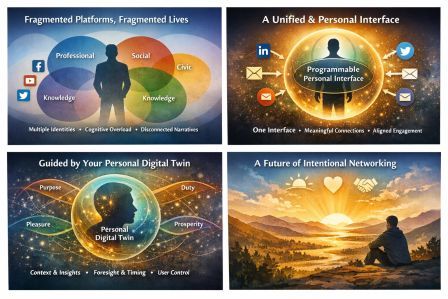
As digital life expands across professional, social, civic, and knowledge platforms, networking has quietly become fragmented. Individuals are now required to maintain multiple personas, manage parallel relationships, and respond to algorithmically driven prompts that optimize for platform engagement rather than human relevance. The result is not just fatigue, but a deeper erosion of coherence—people know who they are on each platform, yet struggle to understand how these interactions serve their evolving life, work, and purpose. This fragmentation has emerged as a structural constraint in modern networking.
A new possibility is beginning to take shape: the emergence of programmable personal interfaces that operate above individual platforms rather than within them. Instead of replacing existing networks, such interfaces would act as a unifying, person-centric layer—allowing individuals to interact with multiple platforms through a single, coherent lens. The desirability of this shift lies not in efficiency alone, but in meaning. By restoring continuity across interactions, such interfaces can support fewer but more relevant connections, better timing of engagement, and greater alignment between personal trajectories and social participation. Networking, in this model, becomes an act of sense-making rather than accumulation.
At the heart of this approach is a user-controlled personal digital twin—not as a replica of the individual, but as a lightweight, evolving model of context, preferences, constraints, and direction. The programmable interface functions as an interactive layer on top of this twin, selectively ingesting signals from multiple networks and synthesizing them into insights rather than actions. Life-trajectory awareness, including concepts such as life curves, may assist this process by offering foresight into readiness and openness, but never by determining behavior. The interface advises, reflects, and contextualizes; it does not speak, act, or decide on behalf of the person.
From a foresight perspective, this represents a deeper shift in how networks may evolve. Power moves gradually from platform-centric recommendation systems toward individual agency infrastructure. Public relations, reputation management, and networking support functions—once handled externally—begin to internalize as assistive capabilities, while human judgment, ethics, and trust remain central. Platforms, in turn, may increasingly function as venues rather than gatekeepers, valued for signal quality rather than attention capture.
The long-term significance of this transition is not technological but civilizational. As lives become longer, careers non-linear, and identities plural, the ability to navigate relationships with clarity and intentionality becomes a form of human infrastructure. A programmable personal interface, grounded in foresight rather than optimization, offers a path toward networks that support growth, contribution, and meaning—without claiming to manage or predict human life. In this sense, the future of networking is not about smarter platforms, but about wiser interfaces that help individuals remain authors of their own journeys.