
Blog Details
- Member
- March 1, 2026
ALTERNATIVES TO RIGID WATER TANKS FOR STORAGE
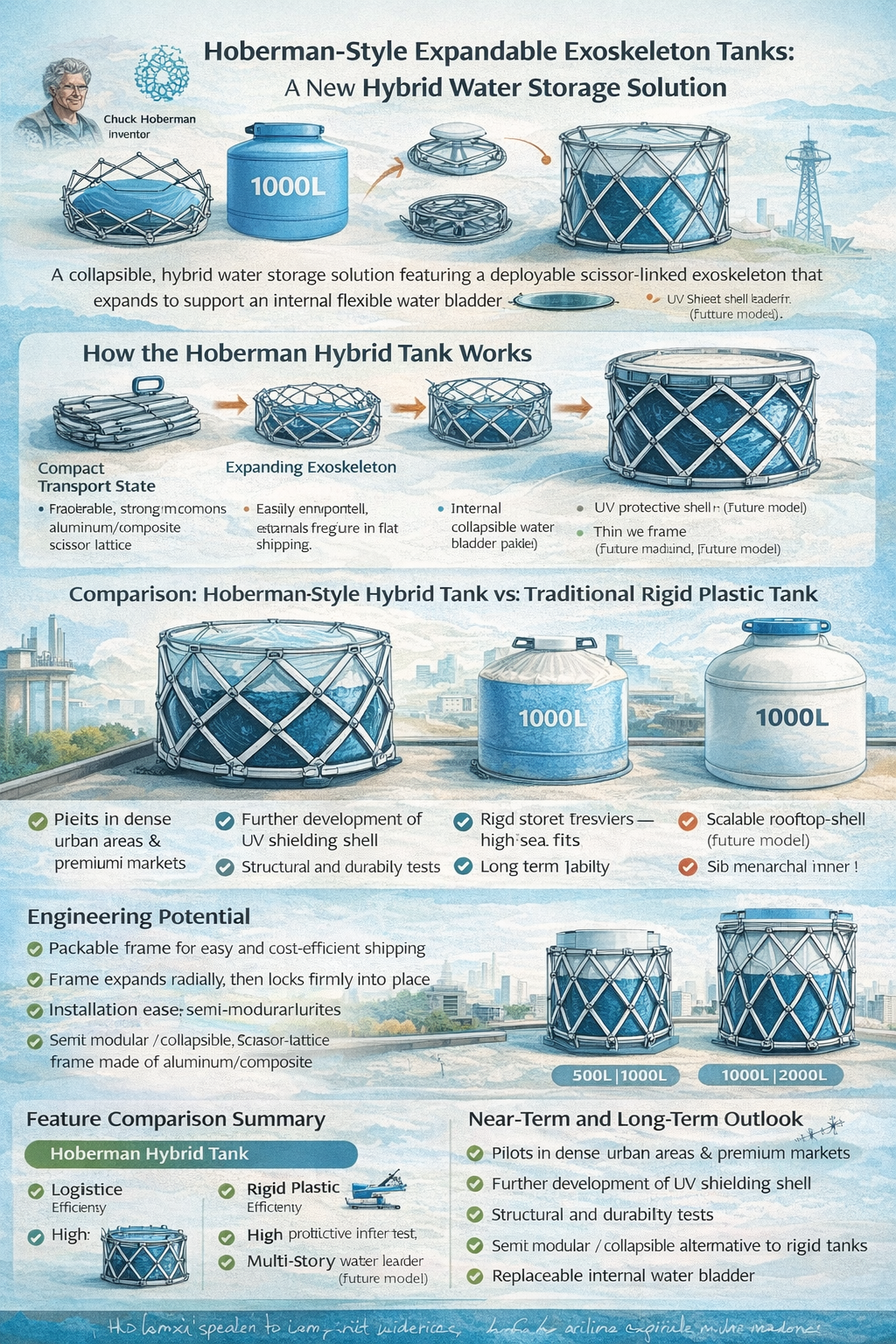
The concept of using a Hoberman-type deployable exoskeleton as the structural envelope for rooftop water storage represents a fundamental shift from monolithic molded containers toward architectural systems. Instead of relying on thick rotationally molded plastic walls to contain hydrostatic pressure, the structure would separate load-bearing and containment functions. A collapsible cylindrical lattice—based on scissor-linked expanding geometry—would provide structural stability, while an internal flexible bladder would hold the water. This decoupling allows each layer to be optimized for its specific function: strength and stability in the frame, impermeability and hygiene in the liner.
From a logistics perspective, the advantage is immediate and structural. Conventional rigid tanks are transported as full-volume cylinders, meaning most of the freight space carries air. A deployable exoskeleton collapses into a compact bundle, and the bladder folds into a small package. This dramatically reduces transport volume, lowers freight cost per liter, and improves distributor storage density. In a country as geographically expansive and climatically diverse as India, where companies like and distribute bulky goods nationwide, such volumetric efficiency could materially alter supply chain economics.
Structurally, the feasibility depends on the ability of the exoskeleton to resist hydrostatic pressure and dynamic loads from water movement. Water exerts outward radial force that increases with depth, placing continuous hoop stress on the cylindrical boundary. A deployable lattice must therefore lock rigidly once expanded. Without a positive locking mechanism, scissor systems remain kinematic and cannot reliably bear sustained load. Reinforcement rings, cross-bracing, and base support plates would likely be required to prevent buckling or joint fatigue. The integrity of pivot joints becomes a central engineering variable, particularly under heat cycling and long-term exposure.
Thermal conditions on Indian rooftops introduce additional design demands. Summer surface temperatures can exceed 60°C, causing expansion, material creep, and degradation over time. The exoskeleton would need corrosion-resistant materials such as coated aluminum or engineered composites, while the internal bladder would require UV shielding and food-grade certification. An optional outer reflective skin could further protect both frame and liner from prolonged ultraviolet exposure. The durability challenge is not trivial, but it is solvable with industrial-grade materials and careful stress testing.
One of the strongest advantages of this architecture is lifecycle flexibility. In traditional rigid tanks, cracks or structural damage typically require full replacement. In a hybrid system, the bladder can be replaced independently of the structural frame. This extends overall service life and reduces material waste. It also allows modular capacity expansion—additional exoskeleton segments could increase height or diameter if the geometry is designed for scalability. Such modularity aligns with the increasing variability of water storage needs in urban and peri-urban India.
However, the design introduces complexity. A rotationally molded tank is inexpensive partly because it has few parts and minimal assembly. A deployable exoskeleton involves numerous joints, precision tolerances, and installation discipline. Manufacturing cost may exceed that of conventional tanks unless scale and design simplification are achieved. Installation quality becomes critical; improper locking or uneven base support could compromise structural integrity. Therefore, early adoption would likely occur in premium or logistics-sensitive segments rather than in the lowest-cost mass market.
From a broader systems perspective, this approach shifts value from bulk material thickness to intelligent structural geometry. It transforms the water tank from a static molded object into a deployable engineered system. The economic logic becomes stronger in environments where freight costs are rising, distribution networks are stretched, and sustainability pressures encourage material efficiency. It also aligns with distributed assembly models, where compact components can be shipped to regional hubs for final deployment and installation.
In summary, a Hoberman-type cylindrical exoskeleton combined with an internal bladder is technically plausible and strategically interesting. It offers substantial logistics advantages, modular repairability, and potential resilience under transport and climate stress. Its success would depend on robust locking mechanisms, joint durability, heat resistance, and cost optimization. While unlikely to immediately displace conventional rigid tanks across all segments, it could open a new category of deployable, hybrid rooftop water storage systems—particularly in markets where transport intensity and lifecycle adaptability are decisive factors.