
Blog Details
- Member
- March 5, 2026
The Periodic Table of Thinking
SRIJAN SANCHAR
A Thought Taxonomy for Structured Reasoning and Conceptual Evolution
Introduction
Human progress has always depended on the ability to think clearly about complex phenomena. Across science, technology, governance, and social systems, progress occurs when ideas are organized, compared, and combined in structured ways. Yet most discussions about thinking remain informal and unstructured, relying on intuition rather than systematic frameworks.
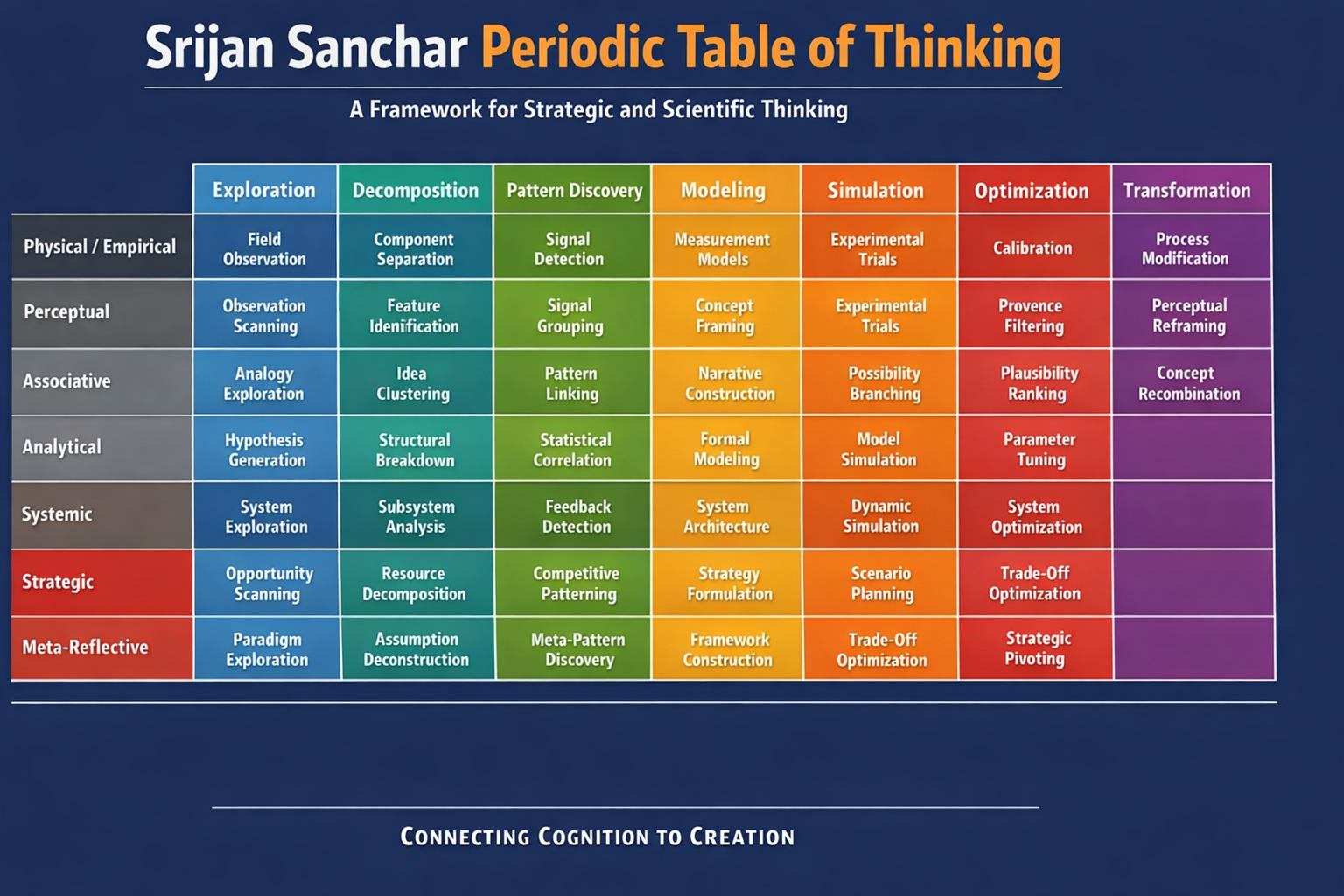
The Srijan Sanchar Periodic Table of Thinking proposes a structured taxonomy of fundamental thinking processes. It organizes core reasoning elements into a coherent system that makes thinking processes visible, combinable, and reusable. Instead of treating thinking as an abstract or mysterious activity, the framework presents it as a structured set of conceptual elements that can interact to generate insights, explanations, predictions, and designs.
Just as the periodic table in chemistry revealed the underlying order of matter, the Periodic Table of Thinking aims to reveal the underlying structure of reasoning. By mapping the core building blocks of thought, it becomes possible to systematically generate new conceptual models, analytical frameworks, and intellectual tools.
The goal of this initiative is not merely theoretical. It is intended to support the development of better models of systems, phenomena, and concepts across multiple domains—from science and technology to policy, economics, and social transformation.
---
Uniqueness of the Concept
The distinctiveness of the Periodic Table of Thinking lies in its attempt to treat thinking itself as a structured domain with identifiable elements and relationships. Most existing approaches to reasoning describe particular methods—such as critical thinking, systems thinking, or design thinking. These approaches provide valuable guidance but usually remain confined to specific domains or styles of analysis.
The Periodic Table of Thinking approaches the problem differently. It treats thinking processes as fundamental cognitive elements that can be combined in many different ways to produce reasoning engines. This allows diverse analytical methods to be understood as combinations of the same basic building blocks.
This approach provides a unifying conceptual structure that can connect multiple intellectual traditions. Analytical reasoning, creative ideation, systems modeling, causal explanation, classification, and foresight can all be viewed as different configurations of core thinking elements.
By identifying these elements and arranging them in a systematic taxonomy, the framework enables a deeper understanding of how reasoning actually works. It also provides a basis for developing new analytical tools and conceptual frameworks by recombining these elements in different ways.
Another unique aspect of the framework is its emphasis on conceptual evolution. Ideas and models are not static. They evolve as new information emerges and as different thinking processes interact. The Periodic Table of Thinking provides a structure within which such conceptual evolution can be understood and guided.
---
Structure of the Periodic Table
The Periodic Table of Thinking is organized as a multidimensional taxonomy of reasoning elements. Each element represents a fundamental cognitive operation used in analysis, interpretation, or synthesis.
These elements include processes such as observation, pattern recognition, categorization, relational mapping, abstraction, system modeling, scenario construction, evaluation, and transformation. Each element captures a specific way in which the human mind engages with information and constructs meaning.
Within the table, elements are arranged in a structured grid that reflects conceptual relationships among them. Some elements focus on discovery and pattern detection. Others focus on organization and classification. Some deal with explanation and causality, while others focus on modeling, prediction, or design.
The structure reveals how thinking processes cluster into families of reasoning. These families include discovery processes, classification processes, explanatory processes, predictive processes, and generative or design processes. Together they form a coherent map of cognitive capabilities.
Because these elements are combinable, the table does not simply classify thinking—it enables the construction of reasoning engines. By linking multiple elements in sequence, complex analytical processes can be created that move from observation to insight, from explanation to prediction, or from understanding to innovation.
In this sense, the table functions not only as a taxonomy but also as a generative architecture for reasoning.
---
Applications Across Domains
The Periodic Table of Thinking has broad applications across many fields that rely on structured reasoning and conceptual modeling.
In scientific research, the framework can support the development of systematic approaches to discovery, hypothesis generation, and theory construction. By clarifying the relationships among different reasoning processes, it helps researchers build more coherent models of natural phenomena.
In technology and innovation, the table can serve as a foundation for structured ideation and problem solving. Innovation often emerges from recombining existing concepts in new ways. By providing a clear taxonomy of thinking elements, the framework enables deliberate recombination of ideas to generate novel solutions.
In policy analysis and governance, the framework can help structure complex decision processes. Policy problems typically involve interconnected systems, competing objectives, and uncertain futures. By combining elements related to system modeling, causal reasoning, and scenario exploration, policymakers can develop more comprehensive analyses and better-informed strategies.
In foresight and strategic planning, the Periodic Table of Thinking provides tools for constructing alternative future scenarios and evaluating their implications. Understanding how patterns evolve and how systems interact is central to anticipating emerging opportunities and risks.
The framework also has potential applications in education. Teaching thinking skills often involves presenting isolated techniques. The Periodic Table of Thinking offers a way to present these techniques within a coherent structure, helping learners understand how different forms of reasoning relate to one another.
---
Toward a Universal Thought Taxonomy
The long-term vision behind the Srijan Sanchar Periodic Table of Thinking is the development of a universal taxonomy of thought processes. Such a taxonomy would provide a common conceptual language for discussing reasoning across disciplines.
This shared language could facilitate collaboration among researchers, strategists, technologists, and policymakers by providing a common framework for describing how ideas are generated, analyzed, and transformed.
Over time, the framework could also support the creation of libraries of reasoning engines—structured combinations of thinking elements that address recurring analytical challenges. These engines could help organizations approach complex problems with greater clarity and rigor.
By mapping the building blocks of thought and enabling their systematic combination, the Periodic Table of Thinking seeks to contribute to a more disciplined and transparent culture of reasoning.
---
Conclusion
The Srijan Sanchar Periodic Table of Thinking represents an attempt to bring structure and clarity to the domain of human reasoning. By identifying the fundamental elements of thinking and organizing them into a coherent taxonomy, the framework provides a foundation for building models of concepts, systems, and phenomena.
Its value lies not only in classification but also in generative potential. The ability to combine thinking elements into structured reasoning processes opens new possibilities for discovery, analysis, foresight, and innovation.
As a Thought Taxonomy, the framework aims to support the evolution of ideas and the development of better intellectual tools for navigating complexity. In a world increasingly defined by interconnected systems and rapid change, the ability to think systematically about concepts and phenomena becomes a critical capability.
The Periodic Table of Thinking offers one possible pathway toward that capability—by making the architecture of reasoning visible, structured, and expandable.