
Blog Details
- Member
- March 18, 2026
TCMS Windows of Opportunity Foresight for Indian Companies
Srijan
Sanchar Windows of Opportunity Foresight
Through the Lens of Srijan Sanchar Drishti
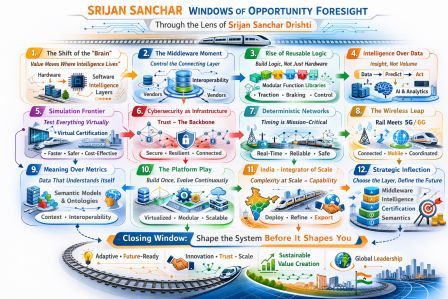
The Srijan Sanchar Windows of Opportunity Foresight highlights a strategic shift in railway systems from hardware-centric designs to software-driven intelligence. It identifies key opportunity layers including middleware, reusable logic, AI-driven insights, simulation, cybersecurity, deterministic networks, and wireless integration. The focus moves from data collection to actionable intelligence and semantic understanding. Virtualized platforms and modular architectures enable continuous evolution. India’s large-scale railway ecosystem offers a unique advantage for integration, testing, and global deployment. The central insight is to strategically position within emerging value layers to shape future systems, rather than follow them, ensuring long-term technological leadership and scalable impact.
1.
The Shift of the “Brain”
“Value Moves Where Intelligence Lives”
The transition defined by
next-generation TCMS standards represents a decisive relocation of value—from
physical control units to software-defined intelligence. What was once embedded
in proprietary hardware is now being abstracted into software layers,
middleware, and data-driven orchestration. This is not just a technological
shift but a structural transformation of the railway system. Srijan Sanchar
Drishti reveals that the true opportunity lies in recognizing where control is
migrating. Indian companies are no longer bound to compete in legacy hardware;
they can directly enter the layers where flexibility, adaptability, and
long-term value are being created.
2.
The Middleware Moment
“Control the Layer That Connects Everything”
As hardware and software decouple,
middleware emerges as the silent orchestrator of system behavior. It determines
how applications interact, how functions are distributed, and how
interoperability is achieved across vendors. Though invisible, it defines the
system’s coherence. Srijan Sanchar Drishti highlights this as a high-impact
opportunity: by building standardized and certifiable middleware platforms,
Indian firms can position themselves at the center of multi-vendor ecosystems,
quietly shaping how the entire system operates.
3.
The Rise of Reusable Logic
“From Building Systems to Building Logic”
The shift toward standardized
function blocks transforms control logic into a reusable, scalable asset.
Instead of designing systems from scratch, the future lies in assembling them
from validated modules governing critical functions like traction and braking.
This elevates logic itself into a tradable industrial product. Srijan Sanchar
Drishti identifies this as a powerful pathway for Indian companies to embed
themselves globally—exporting intelligence rather than hardware, and scaling impact
without scaling manufacturing complexity.
4.
Intelligence Over Data
“Insight, Not Volume, Drives Advantage”
Modern trains generate vast amounts
of data, but raw data alone offers limited value. The real shift is toward
systems that can interpret, predict, and act. AI-driven diagnostics and
prognostics convert monitoring into foresight, enabling early detection of
anomalies and prediction of failures. Srijan Sanchar Drishti emphasizes that
the opportunity lies not in collecting more data, but in building systems that
transform data into actionable intelligence—moving from observation to
autonomous decision-making.
5.
The Simulation Frontier
“Test Everything Without Building Everything”
Virtual certification is redefining
how systems are designed and validated. By simulating thousands of scenarios,
including rare and extreme conditions, it becomes possible to test systems more
thoroughly and efficiently than physical trials allow. This reduces costs and
accelerates innovation cycles. Srijan Sanchar Drishti reveals that Indian
companies can lead in creating these simulation ecosystems, positioning
themselves at the intersection of innovation and regulatory assurance.
6.
Cybersecurity as Infrastructure
“Trust is the New Backbone”
As railway systems become open and
interconnected, cybersecurity becomes a foundational requirement rather than an
afterthought. The integration of digital and operational systems introduces new
vulnerabilities that must be managed continuously. Srijan Sanchar Drishti
identifies a critical opportunity for Indian firms to develop rail-specific
cybersecurity solutions, ensuring resilience and trust in increasingly complex
and connected environments.
7.
Deterministic Networks
“When Timing Becomes Mission-Critical”
The adoption of deterministic
communication networks ensures that critical data arrives exactly when needed.
This transforms networks into precision-engineered systems where timing is as
important as data itself. Mastery of this domain allows firms to operate at the
core of safety-critical infrastructure. Srijan Sanchar Drishti highlights this
as a gateway for Indian companies to move into foundational layers of
next-generation railway systems.
8.
The Wireless Leap
“Where Rail Meets the Networked World”
The convergence of railways with 5G
and 6G technologies is turning trains into mobile nodes within a high-speed
data ecosystem. This enables real-time coordination, advanced automation, and
new operational paradigms. Srijan Sanchar Drishti points to a unique advantage
for India: by combining strengths in telecom and digital systems, Indian
companies can create integrated solutions that redefine connectivity in rail
operations.
9.
Meaning Over Metrics
“Data Becomes Powerful When It Understands
Itself”
As data grows in volume, the
challenge shifts to interpretation. Semantic models and ontologies enable
systems to understand context, relationships, and meaning. This allows machines
to reason about system states rather than merely report them. Srijan Sanchar
Drishti identifies this as a deeply strategic layer—one that underpins
interoperability and advanced intelligence, and where Indian companies can
build enduring advantage.
10.
The Platform Play
“Build Once, Evolve Continuously”
Virtualized and modular control
platforms transform trains into flexible computing environments. Applications
can run independently of hardware, enabling continuous upgrades and easier
certification. This mirrors the evolution seen in other high-tech industries.
Srijan Sanchar Drishti highlights that entering this domain allows Indian firms
to build systems that are not only powerful but also adaptable—capable of
evolving without disruption.
11.
India as the Integrator of Scale
“Complexity at Scale Becomes Capability”
India’s vast and diverse railway
network provides an unmatched environment for deploying and refining advanced
systems. Integrating multiple technologies into real-world operations at scale
is a complex challenge—and a significant opportunity. Srijan Sanchar Drishti
reveals that Indian companies can leverage this environment to develop
integration expertise that is globally relevant, positioning themselves as
orchestrators of complex systems.
12.
The Strategic Inflection
“Choose the Layer, Define the Future”
The industry is entering a phase
where new layers of value are emerging faster than they are being occupied.
This creates a rare opportunity for strategic positioning. Srijan Sanchar
Drishti emphasizes that success will not come from replicating existing models,
but from choosing the right layers—middleware, intelligence, certification, and
semantics—where control and long-term value will concentrate.
Closing
Window: Designing the Future
“Shape the System Before It Shapes You”
The evolution of TCMS reflects a
broader shift from fixed systems to adaptive architectures. In such an
environment, success depends on building capabilities that remain relevant
across multiple possible futures. Srijan Sanchar Drishti provides a way to
navigate this transformation—not by reacting to change, but by actively shaping
it. The opportunity for Indian companies is not just to participate, but to
define how the next generation of railway systems will function and evolve.