
Blog Details
- Member
- June 29, 2026
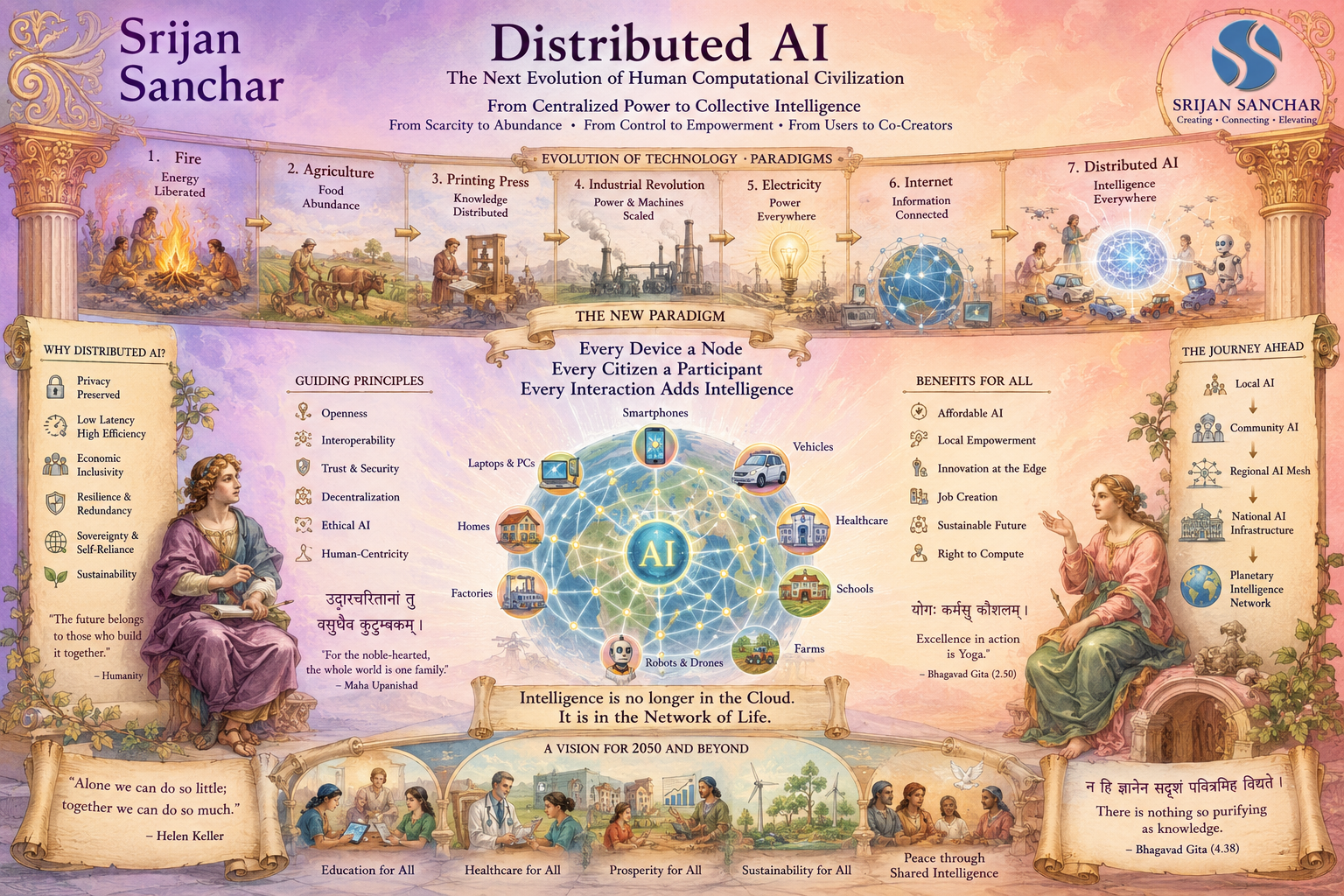
Distributed AI The Next Evolution of Human Computational Civilization
Every major transformation in
civilization has been driven by the same underlying principle: whenever a
scarce capability becomes widely distributed, society reorganizes around that
new abundance. Agriculture distributed food production beyond hunting. The
printing press distributed knowledge beyond monasteries. Electricity
distributed mechanical power beyond watermills. The Internet distributed
information beyond centralized broadcasters. Artificial Intelligence is now
approaching the point where intelligence itself can become a distributed
resource rather than a centralized service.
The first generation of AI has
inherited the architecture of the industrial age. Intelligence is concentrated
inside massive data centers containing millions of processors, vast energy
supplies, and centralized repositories of data. Individuals and organizations
access this intelligence remotely through cloud services, much as factories
once supplied manufactured goods to distant consumers. This architecture has
enabled extraordinary progress but also concentrates computational power,
economic value, and strategic influence within a relatively small number of
organizations.
Technological evolution, however,
rarely remains centralized once the underlying technologies mature. As processors
become smaller, more efficient, and less expensive, intelligence naturally
migrates toward the edge of the network. Modern smartphones, personal
computers, vehicles, industrial machines, drones, robots, and household
appliances increasingly possess computational capabilities that only a few
years ago required specialized servers. What was once scarce becomes
ubiquitous.
This transition fundamentally
changes the nature of computation. Instead of viewing billions of devices as
passive consumers of centralized intelligence, they can be viewed as active
participants in a vast computational ecosystem. Every device contains
processing power, memory, storage, sensors, communication capability, and
increasingly sophisticated AI accelerators. Collectively, these devices
represent an enormous reservoir of computational capacity that remains idle for
much of the time.
The logical consequence is the
emergence of distributed intelligence. Individual devices perform local
inference, preserving privacy while minimizing latency and communication costs.
Groups of nearby devices cooperate to solve larger computational problems by
sharing workloads across local networks. Regional clusters aggregate
capabilities when additional computational power is required, while centralized
data centers become specialized facilities responsible primarily for training
frontier models, maintaining global knowledge repositories, and solving
exceptionally large optimization problems.
This architecture mirrors many
naturally evolved systems. Biological intelligence is not concentrated within a
single neuron but emerges from billions of interconnected cells operating
simultaneously. Human societies derive resilience from millions of independent
individuals coordinating through shared communication networks rather than
through continuous centralized control. Ecological systems achieve stability
through distributed adaptation among countless interacting organisms.
Distributed AI follows the same architectural principle: resilience emerges from
coordinated decentralization rather than concentrated authority.
Economic incentives reinforce this
technological evolution. Cloud-based AI requires continuous investment in data
centers, energy infrastructure, networking capacity, and recurring subscription
payments. These costs are acceptable for some applications but create barriers
for billions of potential users. Running AI locally eliminates much of this
recurring expense while allowing computational resources already owned by
individuals and organizations to be utilized more efficiently. Instead of
paying repeatedly for remote computation, societies begin extracting value from
computational assets that already exist.
For countries such as India, this
transition has strategic significance. Hundreds of millions of smartphones
already form one of the largest distributed computational infrastructures ever
assembled. As device capabilities continue improving, this installed base
becomes a national asset rather than merely a consumer market. Instead of importing
intelligence through expensive cloud services, nations can increasingly
generate intelligence locally by coordinating existing computational resources.
This represents a shift from dependence on external computational
infrastructure toward technological sovereignty.
The implications extend beyond
economics into questions of governance. Historically, infrastructure such as
roads, electricity, telecommunications, and digital identity became
foundational public goods because they enabled broad participation in economic
and social life. As artificial intelligence becomes integral to education,
healthcare, manufacturing, agriculture, governance, and scientific discovery,
access to computational intelligence may similarly evolve into a foundational
capability. The concept of a "right to compute" may become as
significant during the twenty-first century as universal access to electricity
became during the twentieth.
Organizations themselves are likely
to undergo profound structural transformation. Industrial organizations were
designed around centralized information processing because computation was
expensive and communication slow. Hierarchical bureaucracies evolved as
mechanisms for collecting information, making decisions, and distributing
instructions. Distributed AI dramatically reduces the cost of sensing,
analysis, prediction, coordination, and optimization throughout an
organization. Intelligence becomes embedded directly within operational
processes rather than concentrated at managerial layers. Decision-making
progressively shifts toward autonomous coordination among intelligent agents
operating across multiple organizational levels.
This does not eliminate the need for
human judgment. Rather, it changes its location. Routine observation,
monitoring, optimization, and execution increasingly become automated. Human
effort correspondingly migrates toward defining objectives, resolving
ambiguities, managing ethical considerations, designing institutions, and
creating entirely new domains of value. Throughout history, automation has
consistently reduced the proportion of human effort devoted to routine activity
while expanding the absolute frontier of creative contribution. Distributed AI
continues this long historical trajectory.
The transition will not be instantaneous.
Large centralized models will remain indispensable for frontier scientific
research, foundational model training, and computationally intensive reasoning
tasks. Distributed systems will initially complement rather than replace
centralized infrastructure. Hybrid architectures are therefore likely to
dominate for many years, combining global models with local intelligence. Cloud
computing becomes one layer within a broader computational ecosystem rather
than its exclusive foundation.
Significant challenges must still be
addressed. Coordinating billions of heterogeneous devices requires new
protocols for communication, trust, security, identity, privacy, and economic
incentives. Computational workloads must be allocated efficiently despite varying
hardware capabilities, intermittent connectivity, and changing energy
availability. Robust governance mechanisms will be essential to prevent
fragmentation, monopolization, surveillance, or malicious exploitation of
distributed computational networks. Solving these problems represents not
merely an engineering challenge but an institutional one.
The long-term trajectory
nevertheless appears consistent with broader patterns of technological
evolution. Computation is becoming progressively smaller, cheaper, more energy
efficient, and more widely available. Artificial intelligence is becoming more
modular, compressed, and capable of operating locally. Communication networks
continue increasing in speed and decreasing in latency. These trends reinforce
one another, making distributed intelligence increasingly feasible both
technically and economically.
Looking several decades ahead,
civilization may come to regard distributed AI much as it now regards the
Internet. Intelligence will no longer be perceived as residing primarily within
remote servers owned by a few corporations but as a pervasive capability
embedded throughout society. Homes, vehicles, factories, farms, hospitals,
schools, public infrastructure, scientific laboratories, and personal devices
will continuously cooperate through dynamic computational networks. Every node
will simultaneously consume, generate, refine, and exchange intelligence.
The deepest transformation is
therefore conceptual rather than technological. Artificial intelligence ceases
to be a product delivered by specialized providers and becomes an
infrastructural property of civilization itself. Intelligence becomes
increasingly distributed, participatory, adaptive, and locally owned while
remaining globally connected. Just as the Internet transformed information into
a universally accessible resource, distributed AI has the potential to
transform computational intelligence into a shared civilizational capability,
fundamentally reshaping the relationship between individuals, institutions, and
technology.