
Blog Details
- Member
- March 26, 2026
Next Generation Battery Indicators
Adaptive
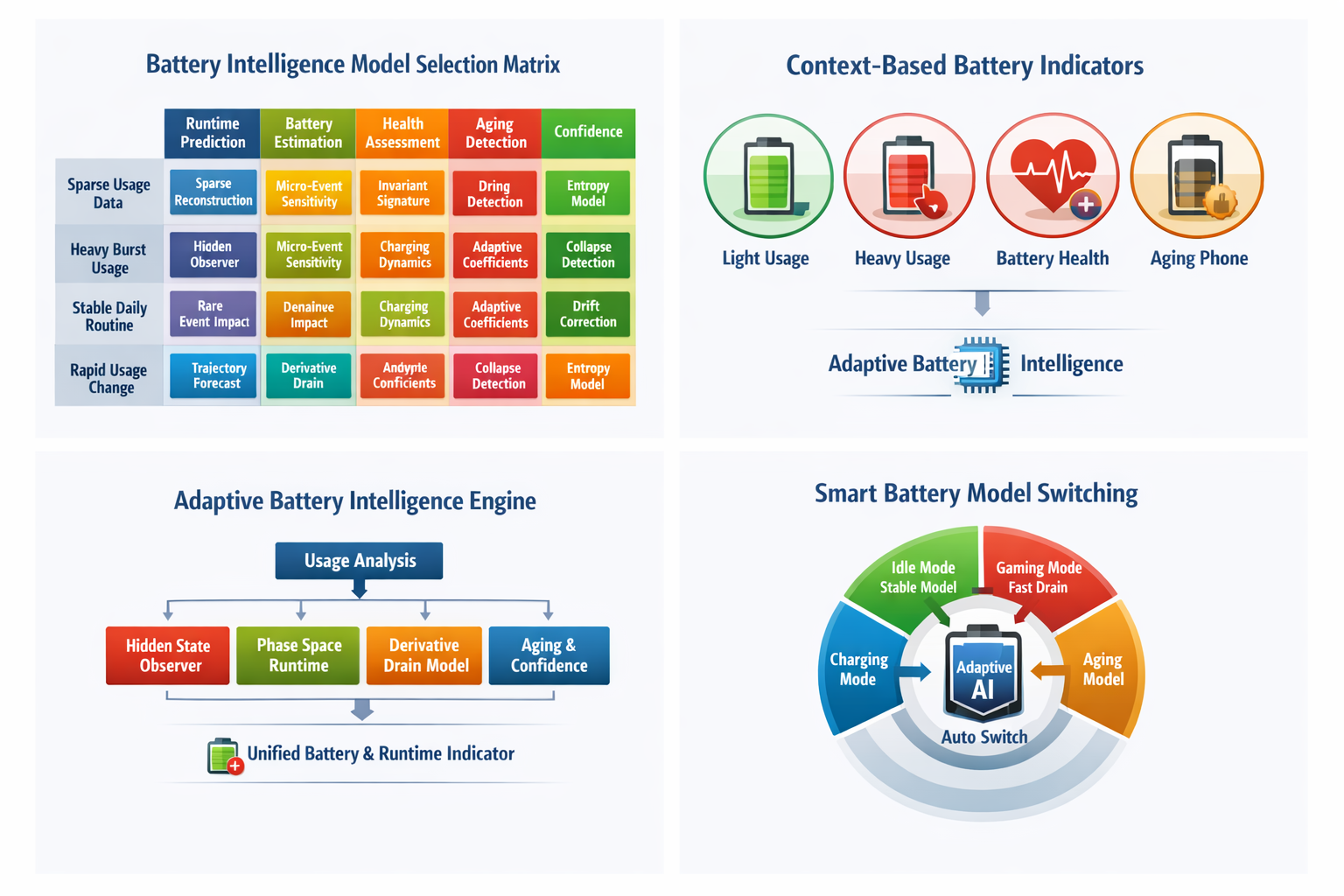
Battery Intelligence Model Selection Matrix
Traditional battery indicators rely
on direct electrical measurements and simple extrapolation. These methods
assume that battery drain follows a predictable linear trend. However, modern
smartphones operate in highly dynamic environments where camera bursts, gaming
spikes, background synchronization, charging habits, and user behavior
introduce nonlinear drain patterns.
A more powerful approach is to infer
battery life from usage history, behavioral patterns, and runtime transitions.
Instead of relying on a single estimation method, multiple software-driven
inference models can be selectively applied depending on the context. The
purpose of this document is to present a structured matrix that guides which
battery life indicator model should be used based on usage conditions,
prediction goals, and system knowledge.
This matrix forms an adaptive
battery intelligence system where the indicator dynamically shifts between
models depending on stability, variability, aging, and uncertainty.
The Adaptive Battery Indicator Matrix
The matrix organizes model selection
across usage conditions and prediction objectives. Each cell represents the
most appropriate inference model for that scenario.
Sparse Usage Intelligence Models
When battery readings are
intermittent or incomplete, the indicator relies on reconstructing battery
behavior from scattered usage samples. In such cases, runtime is predicted
using reconstruction logic, while battery percentage is inferred using hidden
state estimation. Capacity updates occur only during informative events such as
deep discharge or full charge. Confidence is determined from variability in
usage spacing. Learning adapts slowly to avoid noise-driven instability.
Burst Load Prediction Models
During heavy usage bursts such as
gaming, video recording, or hotspot sharing, the battery indicator shifts to
derivative-based prediction. Micro-events like GPU spikes and radio bursts
become dominant. Rare-event penalties are applied to health estimation, and
aging is tracked based on high-load exposure. Confidence becomes probabilistic
since drain becomes unpredictable. Learning adapts quickly to capture nonlinear
interactions.
Stable Routine Optimization Models
For users with predictable daily
patterns, invariant signatures dominate estimation. Runtime is predicted from
repeating schedules. Battery percentage is estimated using daily energy
budgeting. Charging curves provide health information. Drift anchors such as
full charge correct accumulated error. Confidence is high because behavior
variability is low. Learning operates across multiple time scales.
Rapid Transition Handling Models
When usage changes suddenly,
trajectory-based prediction becomes dominant. The system compares the current
usage path with previously observed transitions. Battery percentage estimation
shifts to phase-based behavioral states. Coefficients adapt quickly to capture
the new drain structure. Collapse detection monitors abrupt runtime loss.
Confidence increases in uncertainty conditions and learning accelerates.
Unknown Behavior Exploration Models
For new devices or unpredictable
users, probabilistic runtime prediction becomes primary. A software-based
internal battery model simulates behavior. Hidden observer estimation
stabilizes battery percentage. Rare event detection identifies damaging
patterns. Confidence is expressed as a range. Learning occurs continuously
using simulated and real signals.
Multi-App Interaction Models
When multiple apps operate
simultaneously, drain components interact nonlinearly. Runtime is predicted
using load superposition corrected for interaction effects. Battery percentage
estimation adapts using nonlinear combination models. Aging estimation tracks
usage-dependent degradation. Confidence is expressed as a bounded interval.
Coefficients adapt continuously.
Long-Term Aging Analysis Models
Over extended periods, battery aging
dominates behavior. Multi-scale runtime modeling separates short-term drain
from long-term capacity loss. Adaptive capacity estimation updates slowly.
Collapse monitoring detects sudden degradation. Health is expressed
probabilistically. Learning operates in slow adaptive mode to avoid
oscillation.
Real-Time Prediction Models
When immediate battery prediction is
required, derivative-based runtime estimation is used. Phase-space estimation
tracks behavioral state. Event-triggered updates refine capacity. Drift correction
stabilizes the estimate. Confidence envelope reflects rapid updates. Learning
rate increases temporarily.
Charging-Based Intelligence Models
Charging events provide strong
signals for capacity estimation. Runtime prediction is recalibrated after
charging. Charge curve shape determines health. Aging curve detection tracks
long-term degradation. Confidence is updated after each charging cycle. Anchor
correction stabilizes the system.
Low Computation Mode Models
For low-power devices, simplified
invariant models dominate. Runtime is predicted from typical behavior. Battery
percentage uses behavioral budget estimation. Event-based health updates occur
occasionally. Drift anchors correct slow error. Confidence remains fixed.
Learning proceeds slowly.
Unified Adaptive Battery Indicator
The matrix enables dynamic switching
between models. The battery indicator becomes a composite system where runtime,
percentage, health, and confidence are derived from the most appropriate model.
Stable conditions use invariant models, dynamic conditions use derivative
models, aging conditions use multi-scale models, and uncertain conditions use
probabilistic models.
This produces an adaptive battery
intelligence engine capable of selecting the correct inference method
automatically, improving runtime prediction accuracy, battery percentage
stability, and long-term health estimation without relying on direct hardware
measurements.
MTM Battery Life Indicator Model
Selection Matrix
MATRIX AXES Rows
→ Usage Condition Columns → Objective
|
Condition
↓ / Objective → |
Runtime
Prediction |
Battery
% Estimation |
Health
Estimation |
Aging
Detection |
Confidence |
Adaptive
Learning |
|
Sparse usage data |
Sparse Sampling Reconstruction |
Hidden State Observer |
Event-triggered capacity |
Runtime collapse |
Entropy model |
Adaptive learning rate |
|
Heavy burst usage |
Usage derivative model |
Micro-event sensitivity |
Rare-event impact |
Differential aging |
Probabilistic runtime |
Nonlinear interaction |
|
Stable daily routine |
Invariant usage signature |
Behavioral energy budget |
Charging dynamics |
Drift anchor correction |
Entropy low |
Multi-scale learning |
|
Rapid usage change |
Trajectory forecast |
Phase-space model |
Adaptive coefficients |
Collapse detection |
Entropy high |
Fast learning model |
|
Unknown user behavior |
Probabilistic runtime |
Digital twin model |
Hidden state observer |
Rare event model |
Entropy adaptive |
Digital twin adaptive |
|
Multi-app simultaneous load |
Load superposition |
Nonlinear load interaction |
Differential aging |
Rare-event impact |
Confidence band |
Coefficient learning |
|
Long-term aging analysis |
Multi-scale time model |
Adaptive coefficients |
Differential aging |
Runtime collapse |
Probabilistic |
Slow learning mode |
|
Real-time prediction needed |
Usage derivative |
Phase-space Markov |
Event triggered |
Drift correction |
Confidence envelope |
Fast adaptive |
|
Charging-based inference |
Charging dynamics |
Event triggered |
Capacity estimation |
Aging curve |
Confidence update |
Anchor correction |
|
Low computation mode |
Invariant signature |
Behavioral budget |
Event triggered |
Drift anchor |
Fixed confidence |
Slow learning |