
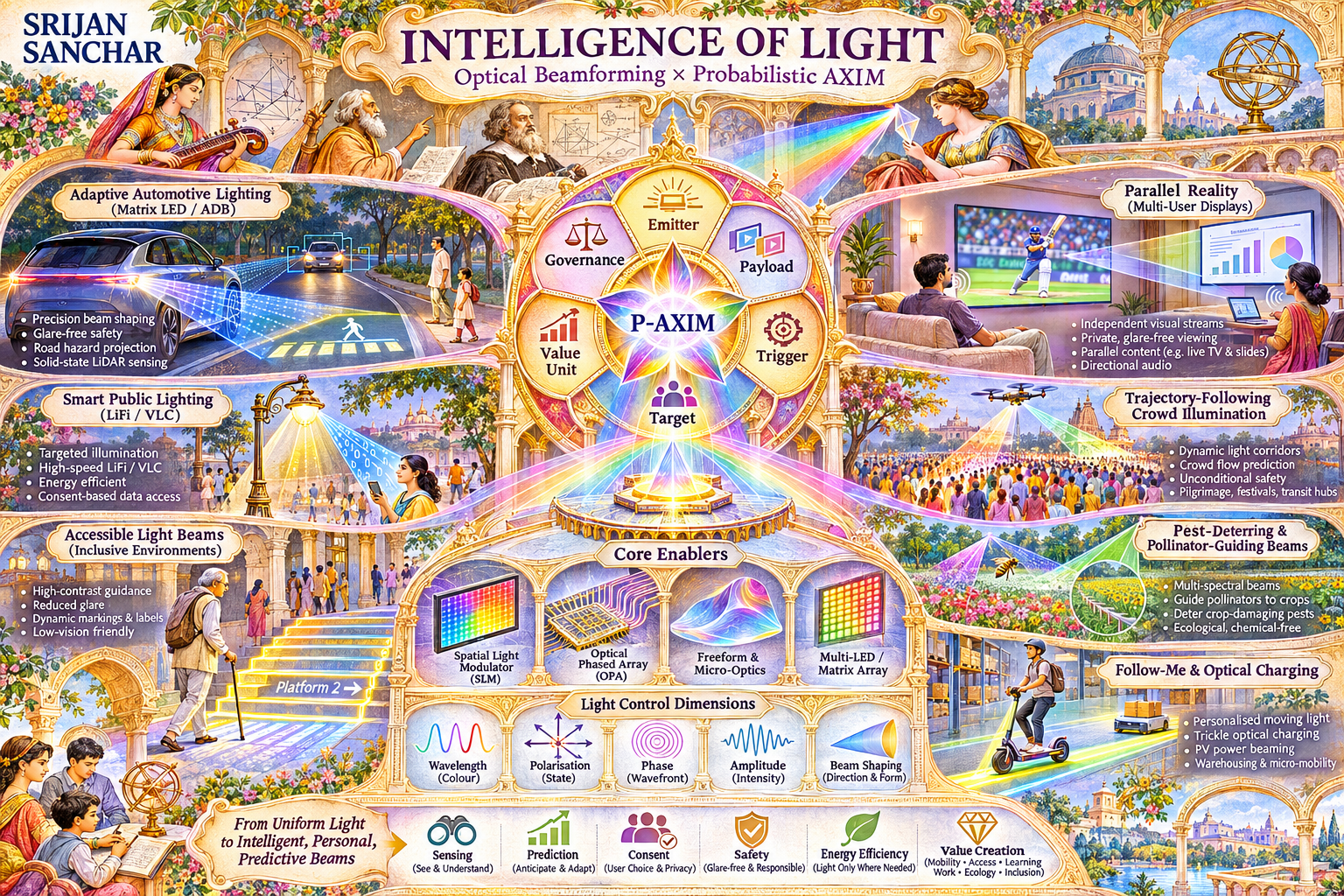
Optical Beamforming for Illumination & Multi-User Displays
Core Technologies, Automotive & Industrial Applications, Parallel Reality Systems, and Novel Concepts Generated via Srijan Sanchar’s Probabilistic AXIM (P-AXIM) Framework
Executive Summary Optical beamforming shifts lighting and display systems from broad, uniform dispersion to active, software-defined steering, shaping, and focusing of light energy. Beyond revolutionizing automotive headlights and solid-state LiDAR, multi-beam optical architectures enable 'Parallel Reality' displays that deliver completely independent visual streams (such as live TV and presentation slides) to different people in the same room simultaneously. |
1. Foundations of Optical Beamforming for Illumination
By controlling the phase, amplitude, wavelength, or geometric path of light waves, optical beamforming systems achieve higher target brightness, sharper beam edges, and major energy savings compared to traditional omnidirectional lamps.
Core Enabling Technologies
Spatial Light Modulators (SLMs): Liquid-crystal-based devices modulate the phase or amplitude of light across individual pixels. Acting as dynamic diffractive elements controlled by electrical signals, SLMs steer and focus LED or laser light onto moving targets without mechanical parts.
Optical Phased Arrays (OPAs): Built on photonic integrated circuits (PICs) using silicon or silicon nitride, OPAs use microscopic optical antennas and phase shifters to steer coherent light beams electronically across wide fields of view.
Freeform and Micro-Optics: Custom-engineered, non-spherical lenses and reflectors reshape standard light distributions (such as Gaussian laser profiles) into uniform flat-top beams or exact geometric footprints.
Multi-LED Hemispherical & Matrix Arrays: In incoherent lighting, arranging LEDs on curved geometries or selectively switching emitters in a dense pixel grid allows dynamic beam steering without wave interference.
Key Illumination Improvements
Targeted Energy Efficiency: Concentrating light strictly onto active zones (a desk, road lane, or exhibit) eliminates spill light and reduces overall power draw.
Adaptive Glare Reduction: Creates real-time 'dark zones' around sensitive eyes or oncoming drivers while maintaining full illumination everywhere else.
Uniformity and Edge Control: Eliminates bright central 'hotspots' and dim edges, delivering even illumination across target surfaces.
Dual-Purpose LiFi and VLC: Focuses modulated LED light onto receiving devices, boosting signal-to-noise ratios by over 12 dB and doubling wireless transmission range while illuminating the room.
Approach | Light Source | Key Mechanism | Primary Applications |
Optical Phased Arrays (OPAs) | Coherent (Lasers) | Wave interference via phase shifters | Solid-state LiDAR, microscopy, precision scanning |
Spatial Light Modulators (SLMs) | Coherent / Partially Coherent | Pixel-level phase/amplitude diffraction | Dynamic indoor spotlighting, VLC/LiFi, holography |
LED Matrix & Freeform Optics | Incoherent (LEDs) | Geometric refraction & selective switching | Automotive adaptive headlights, street & architectural lighting |
2. Automotive & Commercial Deployments
Automotive engineering represents the largest commercial rollout of optical beamforming illumination, branded as Adaptive Driving Beam (ADB) or Digital Matrix LED headlights.
Automotive Implementation & Leading Adopters
Micro-LED & Matrix Arrays: Systems such as ams OSRAM EVIYOS integrate over 25,000 individually addressable LED pixels per headlamp, carving precision shadow boxes around oncoming vehicles while keeping full high beams active.
Digital Micromirror Devices (DMDs): Used by Audi, Mercedes-Benz, and Huawei XPixel (Aito M9, Stelato S9), chips with over 1.3 million microscopic mirrors tilt thousands of times per second to sculpt high-resolution light carpets, pedestrian spotlights, and road hazard symbols.
Rapid Adoption in Chinese EVs: Supported by permissive adaptive-lighting regulations, Chinese automakers (NIO ET9, Huawei-partnered brands, HiPhi, Zeekr) tightly link LiDAR and forward cameras to beamforming headlights to scale projection lighting into mainstream EVs.
Broader Cross-Industry Uses
Solid-State LiDAR: Chip-scale OPAs replace spinning mechanical mirrors on autonomous vehicles, improving durability and allowing dynamic zoom onto distant road hazards.
LiFi & Free-Space Optical (FSO) Links: Steers high-bandwidth data beams to individual indoor devices or locks laser links between satellites (such as Starlink inter-satellite links) across thousands of kilometers.
Medicine & Optogenetics: Holographic SLMs stimulate single neurons in brain research, while flat-top beam shapers prevent collateral tissue damage in LASIK and dermatology.
Smart Horticulture & Manufacturing: Shapes LED footprints to match growing plant canopies in vertical farms and sculpts industrial laser spots into rings or flat-tops for crack-free EV battery welding.
3. P-AXIM Exploration: Novel Illumination & Dual-Use Concepts
Applying Srijan Sanchar’s Probabilistic AXIM (P-AXIM v2: 'Grounded Surprisal') decomposes the illumination problem into six independent axes—Emitter, Payload, Trigger, Target, Value Unit, and Governance—and crosses low-probability states to uncover grounded white-space opportunities.
Concept Title | P-AXIM Axis Combination | System Architecture & Value Proposition | Grounding Status |
1. Trajectory-Following Crowd Illumination | Drone/pole LED arrays + Predictive crowd forecasting + Unconditional safety core | Steers high-intensity light corridors dynamically along predicted crowd surges at festivals, transit hubs, and pilgrimage routes instead of static floodlighting. | Emerging |
2. Parametric Glare-Reduction Insurance | Fleet ADB headlights + Optical telemetry verification + Risk-reduction value unit | Commercial insurers offer parametric discounts verified via optical logs confirming glare-free shadow-boxing and pedestrian spotlighting were active on night routes. | Grounded White Space |
3. Dual-Register Public Streetlights | Municipal streetlamps + Structured LiFi + Core/Shell consent governance | Maintains an unconditional wide 'Core' safety beam while steering invisible or modulated 'Shell' LiFi data beams exclusively to consenting phones or delivery bots. | Emerging |
4. Personalized Visual Accessibility Beams | Indoor ceiling SLMs + Consent-gated wearable handshake + Spectral/contrast tuning | Tracks opt-in smart glasses for low-vision users and projects a high-contrast, glare-free path onto stairs and labels without altering room lighting for others. | Grounded White Space |
5. 'Follow-Me' Optical Charging & Lighting | High-efficiency beamformers + Simultaneous illumination & PV power beaming + Micro-mobility | Illuminates cycle tracks or warehouse aisles ahead of e-scooters/robots while beaming concentrated optical energy onto a top solar receiver to trickle-charge in motion. | Improbable / Research |
6. Pest-Deterring & Pollinator-Guiding Beams | Field-edge beamformers + Multispectral wavelengths + Nocturnal ecological triggers | Projects narrow spectral beams to guide nocturnal pollinators to flowering crop rows while creating optical fences that disorient crop-damaging moths. | Emerging / Contested |
4. 'Parallel Reality' Multi-User Optical Beamforming
Delivering distinct, simultaneous visual or data streams to different people from a single display surface is commercialized as 'Parallel Reality' (pioneered by Misapplied Sciences and deployed by Delta Air Lines). Instead of broadcasting uniform light cones, multi-directional pixels emit millions of controllable rays in specific directions simultaneously.
Naked-Eye Personalized Screens: Non-biometric overhead sensors track opted-in individuals in a viewing zone, steering tailored flight details, languages, or directions straight to each viewer's eyes without glasses.
Multilingual & Shared-Cockpit Displays: Enables a single museum or railway board to display Hindi, English, and Tamil simultaneously to different viewers, or lets a car dashboard beam navigation to the driver while beaming a movie to the passenger.
5. P-AXIM Design: Dual-Feed Room Displays (TV + Slides Simultaneously)
Yes—delivering a full-screen TV broadcast to one person on a sofa and full-screen presentation slides to another person at a desk on the exact same room screen is physically achievable by separating light rays by angle, wavelength, polarization, or time. Applying P-AXIM across six indoor axes (Surface, Separation Mechanism, Audio Companion, Trigger, Content Pairing, Room Archetype) yields five distinct system architectures:
# | Indoor System Concept | P-AXIM Mechanism & Architecture | Grounding Status |
1 | The 'Zero-Screen' Beamformed Wall | A compact ceiling Spatial Light Modulator (SLM) projects two independent light fields onto a wall coated with directional micro-bead retro-reflective paint, paired with parametric ultrasonic speakers beaming TV audio to the sofa and meeting audio to the desk. | Grounded White Space |
2 | Hybrid Shared-Base + Private-Overlay ('Core + Shell') | Everyone in the room sees a shared video or presentation base layer on the screen, while an optical beamformer steers high-contrast private data (speaker notes, confidential metrics, or live tickers) exclusively to the presenter's eyes. | Emerging |
3 | Device-Handshake Auto-Beamforming ('Laptop-Open Trigger') | While a family watches live sports on the living room display, opening a laptop triggers a Bluetooth/UWB handshake; the screen tracks the user's head and carves out a private, eye-steered 'slide beam' without interrupting the match. | Grounded White Space |
4 | Transparent-to-Dual-Feed Smart Glass Partition | An architectural glass partition between a home office and living room stays clear from one angle, beams presentation slides to the office side, and beams TV entertainment to the living room side via a single meta-surface optical layer. | Improbable / Research |
5 | Spectral-Notch Everyday Glasses + Multi-Primary Screen | The screen emits TV using RGB triplet A and slides using slightly shifted RGB triplet B; lightweight, clear everyday glasses with dichroic notch filters let viewers walk freely anywhere in the room while watching independent full-HD feeds. | Emerging |
Key Engineering Trade-Offs (Reality Vector Check)
Seat Freedom vs. Hardware Cost: Naked-eye directional-pixel screens require zero wearables, but effective resolution drops as viewing zones multiply and head-tracking cameras must continuously steer beams. Spectral-notch glasses deliver full 4K clarity anywhere in the room at substantially lower display cost.
Optical Crosstalk (Ghosting): In brightly lit rooms, stray reflections off walls or glass tables can cause faint ghost images of slides to bleed into the TV viewer's zone unless beam angles are tightly collimated.
Mandatory Acoustic Isolation: Visual separation fails if TV audio drowns out a work call; optical beamforming must be paired with parametric ultrasonic audio spotlights or open-ear Bluetooth wearables.