
Blog Details
- Member
- September 21, 2026
Buddha Mahavira and the Transformation of an Idea into Civilizational Reach
THE GREAT DIVERGENCE THROUGH THE SRIJAN SANCHAR TRANSFORM
CHAIN
A Srijan
Sanchar application of the Transform Chain / TAN Operationalization
Hypothesis / Conclusion
The central hypothesis of this analysis is that the long-term
civilizational reach of an idea depends not only on the depth, originality or
ethical force of the idea itself, but on the transformation architecture
through which the idea is crystallized, carried, timed, acted upon, amplified,
adapted and institutionalized. The contrasting historical trajectories of
Buddhism and Jainism, as presented in Amit Amitsinha’s article “The Great
Divergence: Why the Buddha Became Global and Mahavira Remained Local,” provide
a useful historical case for testing this proposition. The article explicitly
argues that the divergence was shaped by geography, imperial patronage,
missionary networks, institutional adaptability, translation, political
legitimacy and historical memory rather than by a simple difference in
philosophical merit.
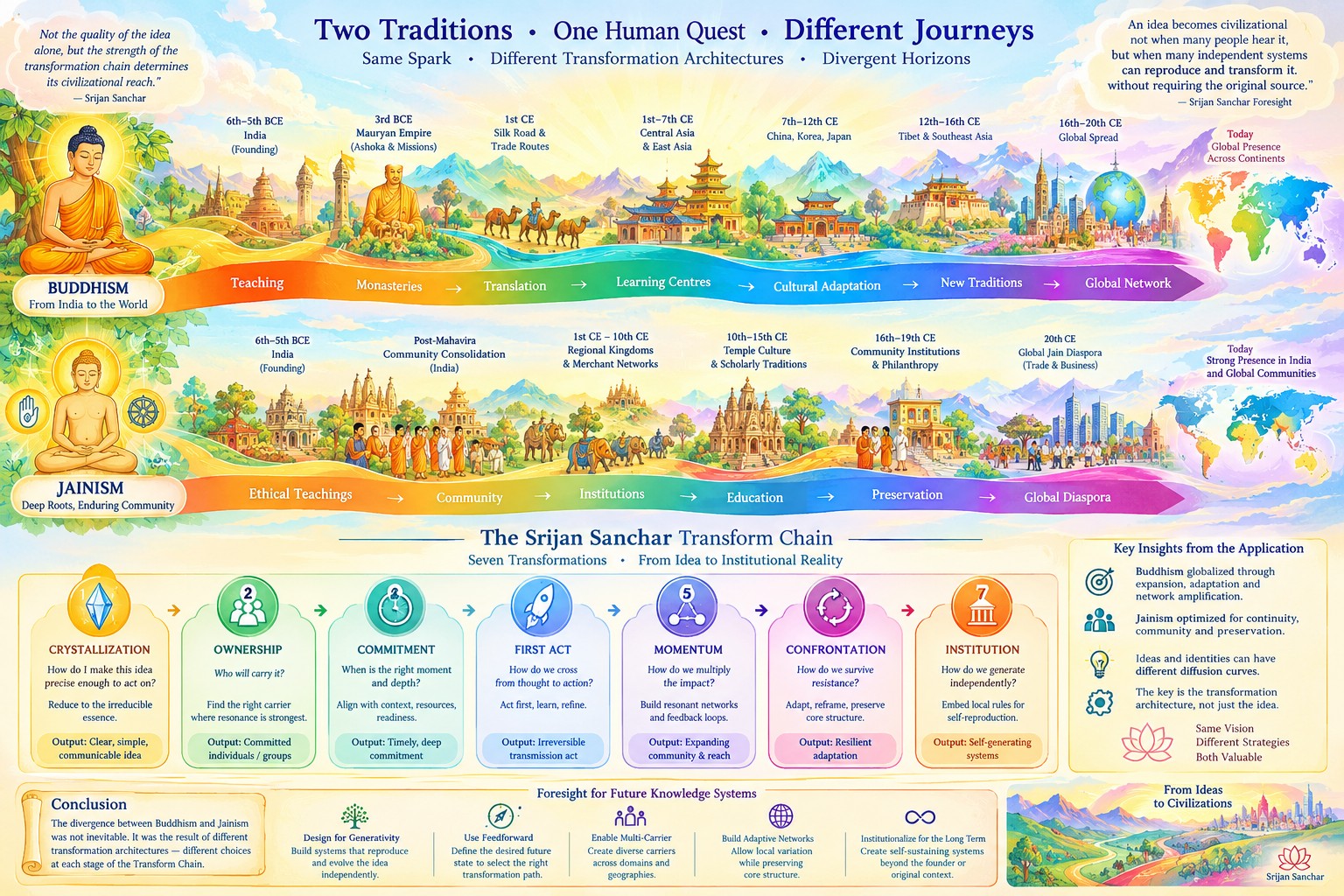
Applied through the Srijan Sanchar Transform Chain, the comparison
suggests a more precise conclusion: Buddhism developed a stronger architecture
for propagation across geographical and cultural boundaries, while Jainism
developed an exceptionally resilient architecture for continuity within a
cohesive community. These are different institutional strategies, not a simple
hierarchy of one philosophy over another. The historical outcome can therefore
be understood as a difference in the capacity of two traditions to move through
the seven transformations from idea to independent institutional reproduction.
The deeper conclusion is that an idea becomes civilizational when
its essential structure can be reproduced by people, institutions and cultures
that were not present at its origin. The decisive transition is therefore not
merely dissemination. It is self-reproduction. A tradition has achieved
civilizational reach when the originator is no longer necessary for the idea to
acquire new carriers, new interpretations, new institutions and new cultural
forms.
1. Source and Analytical Basis
The historical starting point is the article by Amit Amitsinha,
published on Medium on 26 August 2026. The article describes Buddha and
Mahavira as two major śramaṇa teachers emerging from a similar intellectual
environment, while emphasizing that their later historical trajectories
diverged sharply. It attributes the divergence to the machinery of
transmission: geography, imperial patronage, missionary networks, institutional
adaptability, translation projects, political legitimacy and historical memory.
The Srijan Sanchar analytical basis is the attached Transform Chain,
which operationalizes TAN through seven successive transformations:
Crystallization, Ownership, Commitment, First Act, Momentum, Confrontation and
Institution. The framework states that each stage is governed by a different
form of the question “How?”, answered by a specific transform. It further
states that foresight acts as a feedforward signal for selecting among
alternative paths.
The Transform Chain therefore does not replace the historical
argument in the article. It is applied to it as an analytical instrument.
Historical claims are treated as claims made in the source article; the causal
patterns and general propositions derived from the Transform Chain are
analytical inferences from that material.
2. Srijan Sanchar Framework: The Transform Chain
The Srijan Sanchar Transform Chain begins with the proposition that
the journey from idea to institutional reality is not one movement but a chain
of distinct transitions. At each transition the system asks a different form of
“How?”. The transform is the operational answer to that question. The framework
therefore shifts attention from what should happen to what operation must
actually be performed to make the next state possible.
Stage 1 is Crystallization: How do I make the idea precise enough to
act upon? The primary transform is Reduction or Sparse, which strips away
non-essential elements until the structural minimum remains. Stage 2 is
Ownership: How does the idea find the person who will carry it? The primary
transform is Projection, through which the idea is projected onto potential
carriers and finds the strongest structural resonance.
Stage 3 is Commitment: How do I know that this is the right moment
and the right depth of commitment? The primary transform is Phase / Complex
Analytic, which reads the phase of the idea and the receptiveness of the
context. Stage 4 is First Act: How do I begin before I am certain? The primary
transform is Inversion, reversing the usual sequence of planning before acting
so that action itself generates information.
Stage 5 is Momentum: How does one act propagate into many? The
primary transform is System Response / Transfer Function, identifying the acts
and organizational frequencies that amplify rather than dissipate the initial
signal. Stage 6 is Confrontation: How do I navigate resistance without losing
the essential structure? The primary transform is Integral Geometry /
Projection, examining resistance from multiple angles. Stage 7 is Institution:
How does the action become independent of the person who started it? The
primary transform is Emergence, embedding local rules from which the desired
global pattern can generate itself.
The framework adds two important principles. First, each node is a
network rather than a single path: alternative transforms can be activated when
the primary route is blocked. Second, foresight functions as feedforward. The
desired future state determines which available path should be selected, rather
than allowing the system simply to follow the path of least resistance from the
present.
3. Application: Stage 1 — Crystallization
The first analytical question is not which teaching is superior, but
how each teaching becomes communicable beyond its originating circle. The
article presents Buddhism as having a particularly accessible entry point in
the question of human suffering and the possibility of ending suffering. It
associates the Buddha’s Middle Way with an approach capable of accommodating
both monastic and lay practice. In contrast, the article presents Jain
philosophy as a highly structured system involving jīva, karma, liberation and
rigorous ethical purification, with an ethical ideal that places demanding
obligations upon practitioners.
Applied through the Reduction transform, the issue becomes one of
structural accessibility. A globally transmissible idea must be capable of
being recognized before the full philosophical architecture is understood. The
analytical inference is therefore not that Buddhism was philosophically
simpler, but that its entry proposition could travel through a wider range of
social contexts without requiring the complete adoption of the highest monastic
ideal.
This yields the first proposition of the analysis: crystallization
creates the entry point of transmission. If the entry point is too narrow, the
idea may remain intellectually powerful but develop a smaller carrier
population. If crystallization preserves the essential structure while allowing
multiple levels of participation, the potential carrier base expands.
4. Application: Stage 2 — Ownership
The second question is who carries the idea. The article describes
Buddhist transmission through monks, rulers, scholars, translators, pilgrims,
monasteries, universities and trading networks. It gives particular importance
to Ashoka and later periods of state patronage, as well as the movement of
Buddhist monks through the Silk Road and Indian Ocean networks. The article
contrasts this with Jainism’s highly cohesive and resilient community
institutions.
The Projection transform changes the interpretation. Ownership is
not simply enthusiasm. It is structural resonance between the idea and the
position of the carrier. A monk may carry a teaching spiritually; a ruler may
carry it politically; a merchant may carry it geographically; a scholar may
carry it intellectually; a translator may carry it linguistically; a university
may carry it institutionally.
Buddhism appears, in the article’s account, to have acquired a
diversified carrier architecture. Jainism developed a powerful community of
custodians. The distinction is consequential because a community of custodians
is optimized for continuity, whereas a diversified carrier network can connect
the same idea to multiple systems of social reproduction.
5. Application: Stage 3 — Commitment and Phase
The third transformation asks when an idea encounters a context
capable of making commitment consequential. The article places considerable
weight on the political and geographical circumstances surrounding Buddhist
expansion. Ashoka’s Mauryan Empire provided a large political space in which
Buddhist institutions and messages could receive support and missions could be
dispatched. Later periods of patronage further strengthened monasteries and
centres of learning.
Through the Phase transform, Ashoka should therefore not be viewed
merely as an individual patron. The more general analytical interpretation is
that a political phase transition created a transmission opportunity. The
Buddhist idea encountered a combination of political scale, institutional
receptivity, transport networks and emerging interregional connections.
The Jain tradition also received significant patronage from Indian
dynasties, as the article notes, but the article characterizes that patronage
as more regional. The Transform Chain suggests that the relevant difference is
not simply the presence or absence of patronage, but the scale and timing at
which patronage connected with a wider transmission architecture.
6. Application: Stage 4 — First Act and Inversion
Stage 4 is the critical transition from intention to material
reality. The Transform Chain calls for Inversion: instead of waiting until
certainty and preparation are complete, perform an act that reveals information
which further planning cannot generate.
Applied historically, the decisive Buddhist transformation was not
merely the existence of teachings. It was the conversion of teaching into acts
of transmission: missions, travel, monasteries, inscriptions, translation,
pilgrimage and educational institutions. The article describes Buddhist monks
travelling long distances, establishing monasteries in trading centres and
translating scriptures into several Asian languages.
The analytical conclusion is that transmission became real when the
teaching crossed from cognitive or local reality into a material network. A
teaching that remains inside the original community has not yet completed the
First Act of civilizational transmission. The first act is the act that creates
a new location in which the idea can exist independently of its origin.
This also explains why a small first act can have enormous
historical consequences. A monastery at a trading node, a translated text, a
travelling teacher or a royal inscription can become a new node from which
subsequent acts become easier. The first act therefore has informational value
as well as immediate impact.
7. Application: Stage 5 — Momentum and the Transfer
Function
The fifth transformation asks how one act becomes many. The
article’s description of Buddhist history reveals a potentially powerful
cascade: missionary movement created monasteries; monasteries created local
communities and centres of learning; translation created linguistic access;
scholars created new intellectual traditions; rulers and merchants provided
resources; and the resulting institutions became new carriers.
This can be represented as a transfer function: Transmission →
Institution → Learning → Translation → Local Ownership → Patronage → Further
Transmission. The significance is that the output of one stage becomes the
input to the next. The system therefore acquires momentum.
Nalanda is particularly illustrative in the article’s account. It is
described as an international centre through which scholars from different
parts of Asia travelled to India and subsequently carried learning back to
their own regions. In Transform Chain terms, the institution became an
amplifier rather than merely a repository.
Jainism developed a different momentum structure. Its community
institutions, philanthropy, education, entrepreneurship and social cohesion
created remarkable continuity. The key distinction is therefore not that one
tradition had institutions and the other did not. Both did. The difference is
the direction of the institutional transfer function: one became strongly
oriented toward geographic propagation, while the other became strongly
oriented toward community reproduction and continuity.
8. Application: Stage 6 — Confrontation, Adaptation and
Projection
The sixth transformation concerns resistance and environmental
difference. An idea that moves across civilizations encounters new languages,
social structures, political systems, cultural expectations and intellectual
traditions. The article emphasizes Buddhist translation and adaptation across
China, Tibet, Korea, Japan, Southeast Asia and other regions.
Integral Geometry / Projection provides a useful way to understand
this. Resistance cannot be treated as a single obstacle. It can arise from
structural incompatibility, cultural assumptions, institutional interests or
political arrangements. The system must determine which aspects of the original
form are essential and which can change.
The historical implication is that Buddhism’s geographical expansion
required substantial transformation of form without complete loss of identity.
New languages, artistic forms, philosophical schools, institutions and local
political relationships could emerge around a recognizable Buddhist core. The
tradition therefore demonstrated adaptive capacity across projection planes.
The Jain trajectory, as presented in the article, was less
geographically expansive but exceptionally durable within India. Its continuity
suggests that high structural coherence can itself be a survival strategy. The
comparison therefore reveals two different responses to confrontation:
adaptation for expansion and consolidation for continuity.
9. Application: Stage 7 — Institution and Emergence
The final transformation asks whether the system can continue
without its originator. The Transform Chain calls this Emergence.
Institutionalization is not simply preservation; it is the embedding of local
rules from which the desired global pattern can continue to generate itself.
The article’s account of Buddhism demonstrates this transition
vividly. Once Buddhism became embedded in different Asian societies, it no
longer depended on a single Indian centre. New monks, scholars, translators,
rulers, artists and institutions could reproduce Buddhist life within their own
civilizational environments. The originator was no longer necessary for the
system to continue.
The Jain experience demonstrates another form of emergence. The
tradition developed a durable community architecture involving family networks,
education, temples, trusts, philanthropy, entrepreneurship and monastic
lineages. The article describes this as a highly successful form of continuity.
The community could preserve the tradition for more than two millennia even
though it did not acquire comparable transcontinental reach.
This distinction leads to a central analytical proposition:
institutional emergence has at least two directions. It can generate geographic
expansion, or it can generate intergenerational continuity. A system optimized
for one may not automatically optimize for the other.
10. The Central Paradox: Idea Diffusion versus Identity
Diffusion
One of the most important observations in the article is that
Mahavira’s ideas may have diffused more successfully than Mahavira’s identity.
The article points particularly to the wider influence of non-violence,
vegetarianism and respect for life beyond the numerical size of the Jain
community.
The Transform Chain makes this distinction analytically important.
Idea diffusion and identity diffusion are different processes. An idea can be
detached from its original institution, translated into another ethical
vocabulary and absorbed into a different social system. Identity diffusion
requires a stronger carrier architecture: the name, narrative, biography,
symbols, institutions and community must travel with the idea.
Buddhism achieved a large-scale convergence of idea diffusion and
identity diffusion. Jain ethical influence demonstrates that an idea can
diffuse even when the identity attached to its original community remains
geographically concentrated. This is a crucial lesson for knowledge systems,
innovations and social movements.
11. The Founder and the Institution: A Transformative
Inversion
The article also identifies an important paradox in Jain history:
the radical ascetic ideal of Mahavira was preserved by a stable lay community
whose existence depended upon family, wealth, institutions, property, education
and social continuity. This should not be read merely as contradiction. Through
the Transform Chain, it can be understood as institutional transformation.
An institution cannot simply reproduce the founder’s life. It must
translate the founder’s organizing principle into structures that can survive
ordinary social conditions. A wandering ascetic movement requires a lay base
capable of producing children, preserving texts, maintaining sites, mobilizing
resources and supporting institutions. The institutional form is therefore
necessarily different from the originating life-form.
This yields a broader Srijan Sanchar principle: the institution that
preserves an idea must transform the form of that idea while retaining enough
of its organizing structure to remain identifiable. Institutionalization is
therefore not replication. It is structured transformation.