
Blog Details
- Member
- October 27, 2026
From Capturing Attention to Creating Meaning
The Hidden Structure of Media
An independent exploration hypothesis: From signals to systems
1. The hypothesis
What if media is not fundamentally a collection of messages, images, videos and platforms, but a dynamic system in which each visible piece of content expresses only a small part of a larger structure?
A moment of audience disengagement, a viral scene, a successful explanation or a widely shared fragment may reveal something about that larger system. But its meaning cannot be understood from the signal alone. We must investigate the relationships among the content, its sequence, the audience, the medium, the context and the purpose.
The central hypothesis is that media outcomes emerge from the interaction of content structure, audience expectations, distribution mechanisms and human purposes—and that local audience responses can help us discover the larger structures governing those outcomes.
This is an exploratory proposition, not an established universal law. Its value lies in the questions it enables us to investigate.
2. What does this suggest about the world of media?

A. Media has always been about the organisation of attention
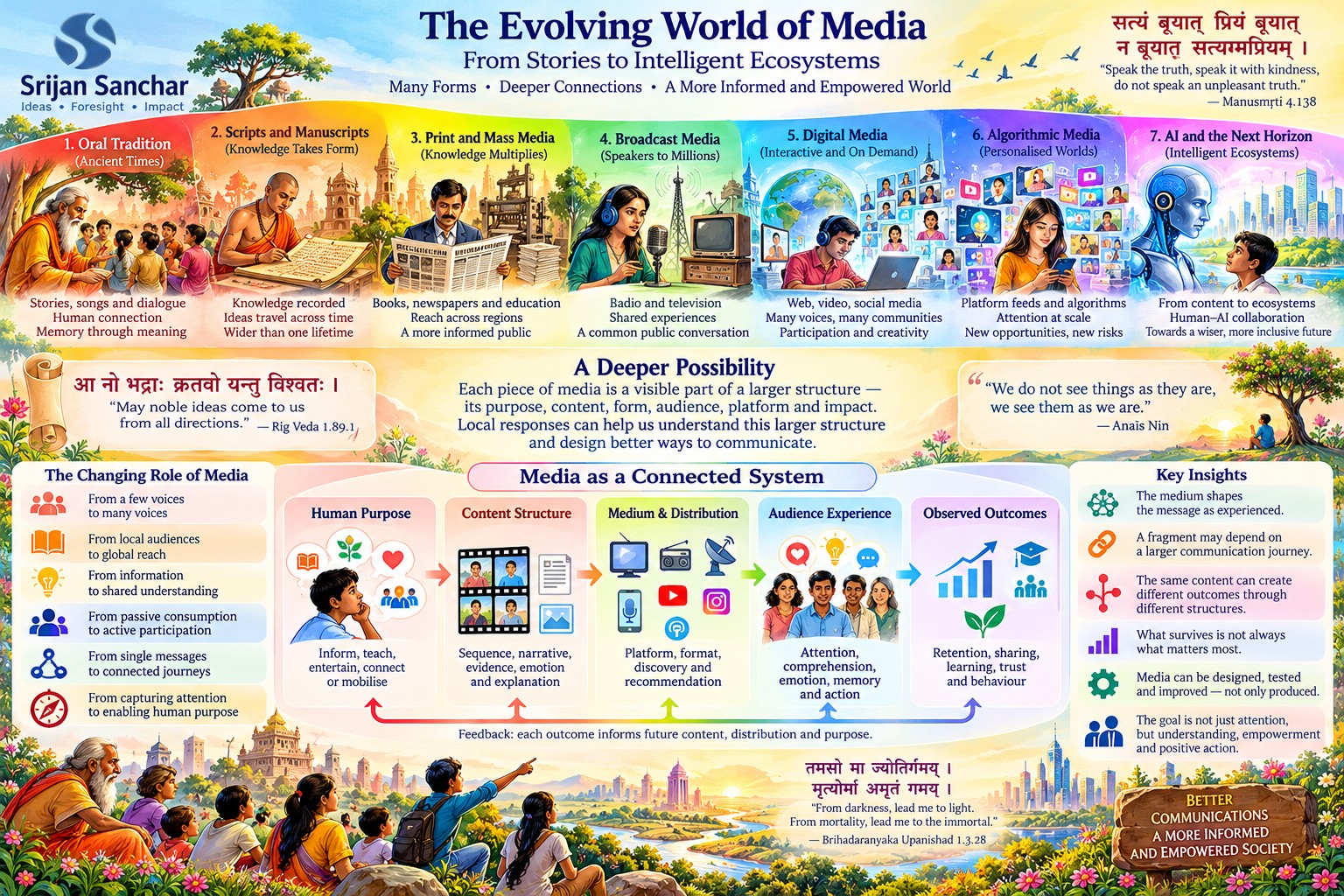
In oral traditions, the storyteller controlled sequence, suspense, repetition, gesture and timing. Print made stories portable and repeatable. Broadcasting synchronised large audiences. Digital platforms personalised distribution, while algorithmic feeds continuously reorder what people encounter.
The technology changes, but the underlying question persists: what makes someone attend, understand, care, remember or act?

B. Content is not independent of its form
A detailed explanation, a 30-second video, a podcast and a classroom exercise may originate from the same knowledge. Yet they are not interchangeable containers.
Each form changes the order in which information arrives, the effort required to understand it, the emotional experience and the next action available to the audience.
The medium does not simply carry the message; it participates in constructing the message as experienced.

C. A media fragment may depend on a much larger structure
A short clip may succeed because its full explanation exists elsewhere. A provocative opening may work because the audience expects a later resolution. A teaching video may lose casual viewers but transform the understanding of those who remain.
The performance of one piece therefore depends partly on what preceded it, what follows it, who encounters it and where it sits within a wider communication journey.

D. The same content can generate different outcomes through different structures
An explanation can precede a demonstration, or the demonstration can come first. A story can be delivered in one continuous sequence or distributed across several connected pieces.
These alternatives may change engagement and understanding even when the underlying facts remain constant. This suggests that media creation is not merely a production activity; it is also a process of designing and testing alternative structures.

E. What survives is not necessarily what matters most
Platforms can measure clicks, viewing duration, completion, sharing and other observable behaviours. These indicators are useful, but none automatically establishes that a message was understood, that its claims were trustworthy or that its purpose was fulfilled.
A system optimised for observable engagement may favour content that captures attention over content that develops understanding. The distinction is fundamental to education, public information and democratic discourse.
3. A possible model of the media system
The hypothesis suggests that media should be studied as a connected system rather than as isolated pieces of content.
Human purpose
Inform, teach, entertain, connect or mobilise
Content structure
Sequence, narrative, evidence, emotion and explanation
Medium and distribution
Platform, format, discovery and recommendation
Audience experience
Attention, comprehension, emotion, memory and action
Observed outcomes
Retention, sharing, learning, trust and behaviour
A conceptual model with feedback: observed outcomes inform future content, distribution and purpose decisions.
The arrows should not be interpreted as a simple one-way causal chain. Audience expectations influence content design; platform distribution influences who sees it; observed responses influence future production; and social context can alter every stage.
The research challenge is to discover which relationships matter, under what conditions, and for which purposes.
4. A surprising implication: media may become a system of connected versions
The conventional unit of media production is often a finished artefact: one film, one article, one video or one podcast episode.
But what if the more useful unit were a coordinated family of versions?
Consider a lesson on a scientific concept:
A short video attracts attention through a question.
A full lesson develops the explanation and demonstrates the method.
A visual summary supports recall.
A discussion addresses misunderstandings.
A practical task tests application.
The versions do not need to repeat the entire message. They can distribute its functions across a connected sequence, provided that each version is intelligible and the overall journey fulfils the intended purpose.
This changes the design question from How do we cut the original into smaller pieces? to How should the knowledge be organised across different encounters?
The same idea could apply to journalism, public-health communication, professional training, cultural education and institutional outreach.
5. The deeper possibility: a science of media structure
If the hypothesis is fruitful, it could lead to a research programme with five questions.
Research question | What it could reveal |
|---|---|
What structural features consistently predict audience disengagement? | Relationships between content organisation and attention |
When does changing the sequence improve understanding? | The role of ordering, demonstration and explanation |
How does platform context alter the effect of the same content? | Interactions between format, distribution and audience expectations |
How can multiple versions work together? | Cross-platform communication pathways |
When do engagement metrics conflict with human purpose? | The limits of optimisation and the need for richer outcome measures |
The crucial methodological principle is to distinguish observation from explanation. A retention dip is an observation; cognitive overload is one possible explanation. A successful edit is evidence about a particular case; it does not establish a universal rule.
Repeated testing across audiences, languages, platforms and purposes would be necessary to determine which relationships generalise.
6. The central tension in the future of media
Media systems increasingly have the capacity to personalise content, test alternatives and optimise delivery at enormous scale. These capabilities create opportunities for more accessible education, more relevant communication and better use of creative resources.
They also create a danger: the ability to optimise attention may advance faster than our ability to define what attention is for.
A system can become exceptionally good at retaining an audience without making that audience better informed. Equally, a communication that attracts a smaller audience may produce substantial learning, insight or social value.
The future challenge is not to abandon measurement or optimisation. It is to broaden the objectives being measured and to keep the purpose of communication explicit.
7. The proposition worth exploring
Perhaps the next stage in media evolution is a movement from content production towards communication architecture.
In this conception, creators do more than produce artefacts. They design sequences of encounters, test alternative structures, learn from audience responses and coordinate multiple forms around a coherent purpose.
The most valuable media system would not simply predict what captures attention. It would help us understand why people respond, which alternative structures could serve them better, and whether the resulting communication actually achieves its intended purpose.
That possibility offers a productive meeting point between mathematical reasoning, media studies, cognitive science, human-computer interaction and the practical craft of storytelling.
The world of media may be understood not only through the messages it produces, but through the hidden relationships that determine how those messages are encountered, interpreted, remembered and acted upon.