
Blog Details
- Member
- September 13, 2026
Transforming PhD Research in India into a National Engine of Prosperity and Wellbeing
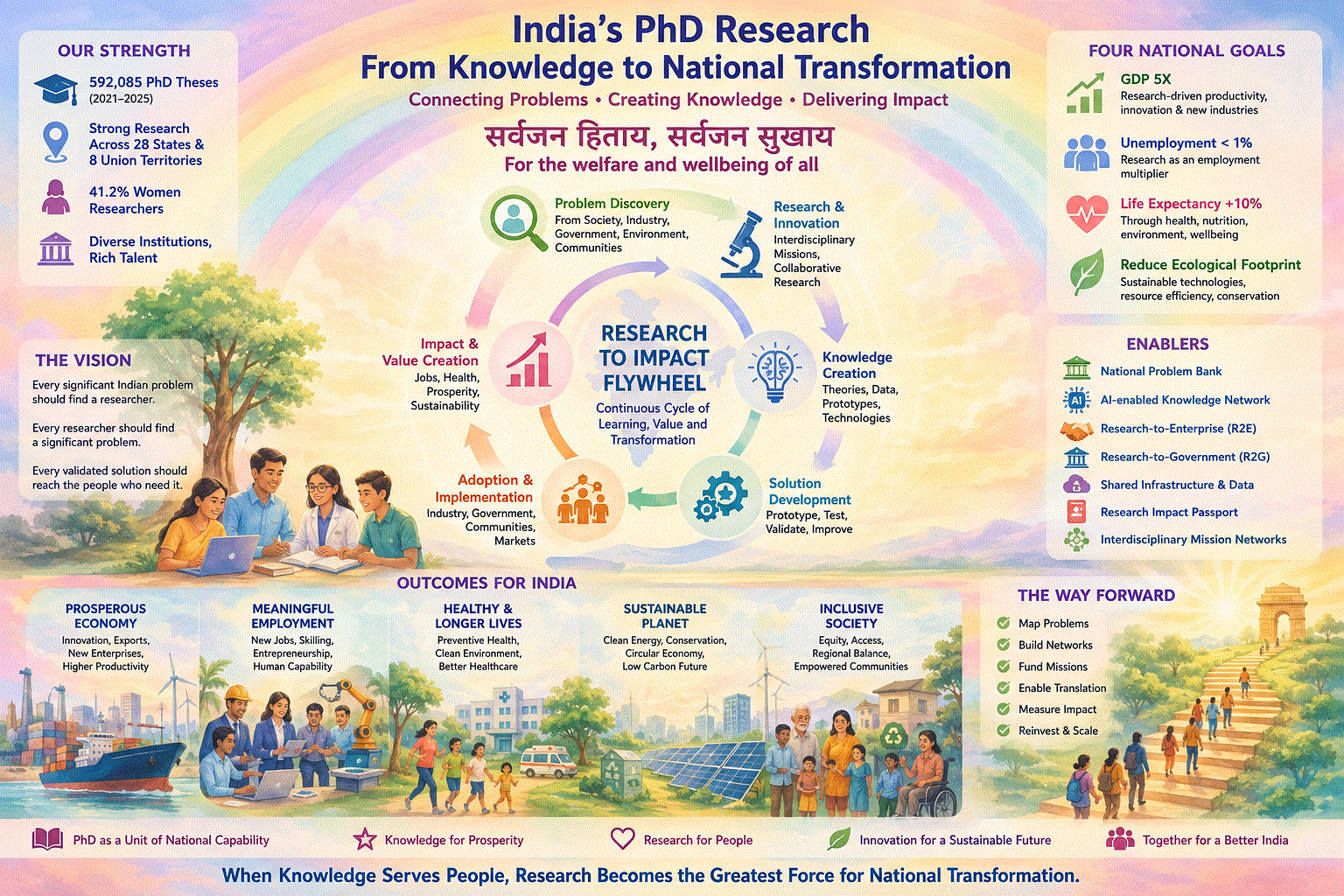
India stands at an unusual moment in its research journey. The country is producing a very large volume of doctoral research, yet the full value of this intellectual effort is not necessarily reaching society, industry or the economy. The analysis presented in the attached material, covering 592,085 PhD theses from 2021–2025, points to a substantial and geographically distributed research base, with particularly large doctoral outputs from Tamil Nadu, Uttar Pradesh, Maharashtra, Karnataka and the Delhi NCR. It also points to differences in research infrastructure and practices between premier institutions and regional universities.
The central challenge, therefore, is not simply to produce
more PhDs. India needs to transform the PhD from primarily an academic endpoint
into a national knowledge-to-action system. A doctoral thesis should
remain a rigorous contribution to knowledge, but it should also have the
possibility of becoming a technology, a new enterprise, a public policy, a
better public service, a new manufacturing process, a healthcare intervention, an
ecological solution, a new educational practice or a deeper understanding of
India's social and cultural challenges.
This does not mean that every PhD must become a startup or
generate immediate commercial returns. Fundamental science, mathematics,
philosophy, history, literature and other forms of scholarship may create value
many years or even generations later. The objective should instead be to ensure
that every doctoral contribution is connected to a larger landscape of human,
scientific, economic, social, cultural or ecological capability.
The first major change should therefore be in the way
research problems are generated. Instead of research beginning predominantly
with an individual researcher identifying a narrowly defined academic question,
India could increasingly allow important problems from districts, cities,
villages, industries, hospitals, farms, public institutions and communities to
become sources of doctoral research questions. A farmer's problem, an MSME's
productivity constraint, a city's pollution challenge, an elderly person's
difficulty in accessing healthcare, a railway safety problem or a
water-management challenge could become the starting point for several
disciplines of research.
This would create a fundamentally different relationship
between society and universities. Society would not merely be the beneficiary
of research; it would become a source of research questions. Universities would
become places where societal problems are converted into knowledge,
experimentation, prototypes and solutions.
India could establish a continuously updated National
Problem Bank, complemented by problem portfolios at the state, district and
city levels. Problems could be submitted by citizens, government departments,
industries, farmers, hospitals, educational institutions and civil-society
organisations. Researchers could then discover not only what has already been
studied, but also which important problems remain inadequately understood.
The enormous existing body of doctoral work could
simultaneously be converted into a national knowledge resource. Hundreds of
thousands of theses contain experiments, observations, datasets, designs,
theories, local knowledge and unsuccessful approaches. Much of this knowledge
remains difficult for another researcher, entrepreneur, policymaker or
community to discover and use. An AI-enabled national research knowledge system
could connect theses, researchers, datasets, laboratories, patents, companies, government
programmes and unresolved problems.
The objective would be to make it possible for a researcher
to ask a simple question: "Who in India has already worked on this
problem, what did they discover, what remains unresolved, and who could help me
take the next step?" Such a system could substantially reduce
duplication while increasing collaboration.
A second major transformation should be to organise research
around missions rather than only disciplines. India's most consequential
problems rarely belong to one academic department. Improving food security, for
example, requires agriculture, biotechnology, logistics, materials science,
economics, behavioural science, water management and climate research.
Improving longevity requires medicine, nutrition, environmental science, urban
design, psychology, public health and technology.
A single national or regional mission could therefore
generate a portfolio of interconnected PhDs rather than hundreds of isolated
theses. Twenty researchers working on different aspects of the same problem
could collectively produce much greater societal value than twenty researchers
working independently without connection to one another.
The same principle can transform the relationship between
universities and industry. Research should have clear pathways through which
promising discoveries can move from the laboratory to prototype development,
field testing, certification, manufacturing, licensing or entrepreneurship.
Universities should not be expected to become businesses, but they should
become much better connected to institutions capable of converting knowledge
into products and services.
India could develop permanent Research-to-Enterprise
and Research-to-Government interfaces around universities and research
clusters. Their purpose would be to identify research with potential users and
help move it toward adoption. A successful outcome would not necessarily be a
patent. It could be an MSME adopting a new process, a government department
changing a procedure, a hospital implementing a new diagnostic method or a
community adopting a more sustainable technology.
This also changes the meaning of employment. PhD research
should increasingly be viewed as a potential employment multiplier. A
doctoral researcher who develops a low-cost manufacturing technology may create
jobs far beyond the researcher. A new agricultural process can create rural
employment. A healthcare technology can generate an ecosystem of technicians
and service providers. An innovation that enables thousands of MSMEs to
increase productivity can create much more employment than the original
research project itself.
Consequently, doctoral research should increasingly ask not
only, "What knowledge have we created?", but also, "What
productive human capability could this knowledge unlock?"
This is particularly important if India aspires to move
towards extremely low unemployment. Achieving unemployment below one percent
cannot be guaranteed by the research system alone, but research can contribute
to the conditions required for such an outcome by creating new industries,
improving productivity, enabling entrepreneurship and making previously
underutilised human capabilities economically productive.
The same transformation should be applied to India's
aspiration for a substantial increase in life expectancy. Longevity cannot be
treated simply as a medical research problem. Clean air, safe water, nutrition,
sanitation, mobility, housing, mental wellbeing, preventive healthcare,
workplace safety, ageing, diagnostics and affordable medical technologies all
influence the length and quality of human life.
India could therefore organise doctoral research around a
broad National Longevity Mission, in which medical researchers work
alongside engineers, environmental scientists, nutritionists, social
scientists, designers, economists and policymakers. The objective would not
merely be more medical publications, but measurable improvements in the conditions
that allow people to live longer and healthier lives.
Ecological sustainability requires a similar change in the
research question. Economic development and environmental protection should not
be treated as permanently opposing objectives. Doctoral research can be
directed toward discovering ways of producing more value with fewer resources.
Materials research, circular manufacturing, renewable energy, water efficiency,
low-carbon transport, sustainable agriculture, biodiversity conservation and
waste reduction can become major areas of research-driven economic opportunity.
Every major research programme could therefore include an ecological
impact dimension. Researchers should be encouraged to consider what happens
when their solution is scaled from a laboratory experiment to a city, a state
or the entire country. A technology that appears sustainable at small scale may
have very different consequences when deployed millions of times.
The economic objective should similarly extend beyond
measuring the number of publications or patents. India needs to understand the economic
value generated by research through productivity gains, new enterprises,
exports, import substitution, public-sector savings, new industries and
improved human capability. This does not mean abandoning publication and
citation metrics; it means placing them alongside broader measures of value.
A new kind of doctoral portfolio could therefore accompany
the conventional thesis. Alongside the academic contribution, the researcher
could document the problem addressed, potential users, possible applications,
prototypes, datasets, intellectual-property possibilities, policy relevance,
employment potential, social consequences and ecological implications. For
fundamental research, the portfolio could instead describe potential long-term
scientific significance.
Such a system would also help democratise research. The
material indicates that research capacity and advanced research practices are
unevenly distributed across institutions. The answer should not be to
concentrate all serious research in a small number of elite institutions.
India's scale requires a network in which regional universities, state
institutions, specialised laboratories, industry and communities can
participate in national research missions.
A researcher in a regional university should be able to
access specialised equipment elsewhere. A university should be able to find an
industrial partner in another state. An MSME should be able to discover a
researcher who has already solved a relevant technical problem. A district
administration should be able to locate evidence produced by researchers
several hundred kilometres away. A student should be able to join a national
research mission without being limited by institutional boundaries.
This would turn India's research system from a hierarchy
into a network of distributed intelligence.
The role of artificial intelligence in this transformation
would be particularly important. AI could help map India's existing theses,
identify connections between apparently unrelated research areas, discover
duplication, identify research gaps, connect researchers with laboratories and
companies, and reveal analogies between problems in different disciplines. The
purpose would not be to replace researchers but to make India's collective
research intelligence more visible and accessible.
Perhaps the most important change would be cultural. A young
researcher should gradually come to see the PhD not merely as a route to a
university position, but as an opportunity to become a creator of knowledge and
capability. Universities should celebrate the researcher who discovers a new
theory, the researcher who creates a company, the researcher whose work
transforms a government programme, the researcher who improves the lives of a
community and the researcher whose fundamental discovery may influence science
decades later.
The ultimate transformation can be expressed as a simple
chain:
Problem → Research → Knowledge → Experiment → Solution →
Adoption → Productivity/Wellbeing → Reinforcement → New Research.
When this cycle becomes continuous, research stops being an
isolated academic activity and becomes part of the country's economic and
social development infrastructure.
India could then create a powerful national feedback loop.
Successful research would generate new technologies, enterprises, public
savings, better services and social benefits. These outcomes would create
demand for more research and greater investment in research infrastructure.
Better infrastructure would produce better researchers and better research,
which would generate further solutions.
The ultimate objective should therefore not be to maximise
the number of PhDs. It should be to maximise the capability created by PhDs.
If India's vast doctoral population can be connected with
India's unresolved problems, its industries, its communities and its public
institutions, the country could potentially convert one of its greatest
under-recognised assets—its accumulated intellectual effort—into a powerful
engine of development.
The four aspirations of fivefold economic expansion,
extremely low unemployment, substantially greater longevity and a declining
ecological footprint should consequently be treated as interconnected
rather than separate goals. Higher productivity can generate prosperity;
research-driven innovation can create employment; healthier environments and
better healthcare can extend life; and resource-efficient technologies can
allow economic development with a smaller ecological burden.
But the final measure of success must be broader than GDP.
The deeper purpose is to create an India in which knowledge
is not concentrated merely in institutions, prosperity is not concentrated
merely in sectors, innovation is not concentrated merely in a few cities, and
the benefits of development are not concentrated merely among those already
equipped to capture them.
The guiding principle can therefore be expressed in the
ancient aspiration:
सर्वजन हिताय, सर्वजन सुखाय
For the welfare of all; for the happiness and wellbeing
of all.
In this vision, the Indian PhD becomes more than a degree.
It becomes a unit of national intelligence, a seed of innovation, a
potential creator of employment, a contributor to human longevity, and a
possible instrument of ecological regeneration.
And the larger national ambition becomes:
Every significant Indian problem should be able to find a
researcher; every researcher should be able to find a significant problem; and
every validated solution should have a pathway to reach the people who need it.
That is how India's enormous doctoral knowledge base could
become not merely a record of what India has researched, but an infrastructure
for what India can become.